The Product Management Tax Tom Verrilli’s line — “we regret that product management exists” — is deliberately provocative. It works because it says out loud what many engineers, designers, founders, and executives have quietly felt: product management can become a standing tax on teams that already know what they are doing. Despite agreeing wholeheartedly with
Transport is local, but not only local The principles are hard to argue with Subsidiarity has a long intellectual pedigree. I’d argue, as would the new resident in Number 10, that local accountability produces better decisions, and that proximity to the problem can sharpen the answer. Local level decision making, at scale, becomes a form of
Search is not a solved problem The first question and the first answer… Origin, destination, time, date, passenger count. It's the first question we ask, the first expression of customer intent and the quality of that first answer shapes everything that follows - confidence, trust, willingness to book, and likelihood to return. Typically, companies invest
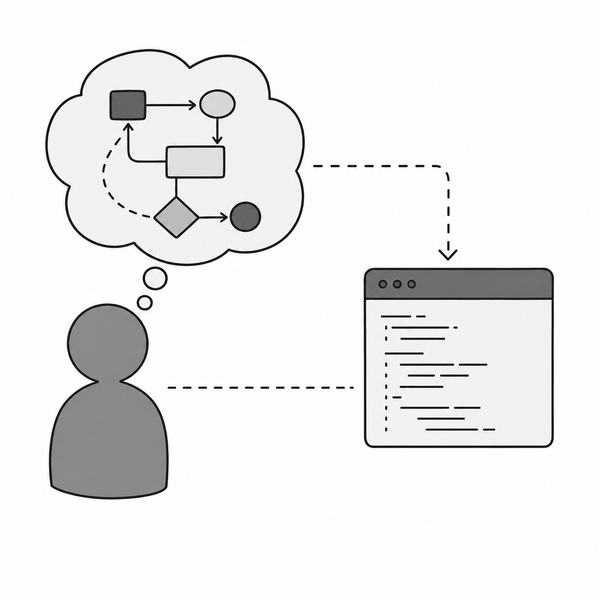
What AI Reveals About Programming TL;DR: Peter Naur argued in 1985 that programming is fundamentally theory-building — the code is the shadow of the mental model in the programmer's head. AI vindicates him sharply: the bottleneck was never code generation. But there's a flip side Naur didn't foresee,
Most flywheels are loops Open a growth strategy deck and you may find a flywheel diagram. A circle of arrows. Steps that feed into each other. "The flywheel effect." Spoiler: Many (dare I say most) are not flywheels. This is not merely semantics. The distinction between a loop and a flywheel has
AI AI and the Decision Moment Part 2 of 5 — Wrong but useful TL;DR: AI doesn't deliver smarter segmentation, it eliminates segmentation as the primary inference method. The individual × moment × context granularity that demand modelling has always needed is now feasible. This post explains the mechanism, and why rail's scale makes
The Comfortable Approximation Last week I attended a transport committee meeting for one of our major Northern cities. Around the table: the constituency MP, national infrastructure providers, representatives from transport carriers, fleet/rolling-stock manufacturers, local authority officers, transport planners, access campaigners and passenger advocates. I have worked in travel for a while
Department of innovation? The announcement Earlier this year, Rail Minister Lord Peter Hendy announced the creation of GBR-X, a new body within Shadow Great British Railways, tasked with driving strategic innovation across the network. Its mandate, in Hendy's own words, is to "break the pattern of slow adoption that
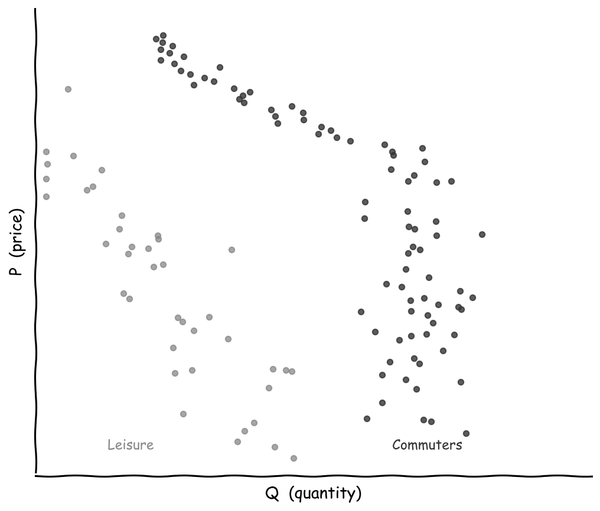
supply-and-demand There is no demand curve 📍 Part 1 of 5 — Wrong but useful "All models are wrong, but some are useful." — George Box, 1976 This series applies that principle to how rail retail models demand. The demand curve is wrong — but for decades it has been useful enough. This post argues it no longer