Search is not a solved problem

The first question and the first answer…
Origin, destination, time, date, passenger count. It's the first question we ask, the first expression of customer intent and the quality of that first answer shapes everything that follows - confidence, trust, willingness to book, and likelihood to return.
Typically, companies invest heavily in acquisition, less on conversion optimisation, less still in post-booking experience. In my experience, beyond the basics, little attention is paid to search as a lever in and of itself - not because the technology can't do better, but because nobody asked it to - the incentives have not been there.
Modern search assumes too much
The dominant paradigm is built around precision: fixed origin, fixed destination, specific date, approximate time. Enter the details, get the results, make a decision.
This model assumes the customer knows exactly what they want before they've started looking. Often they don't. They want to visit somewhere next month and want to know what's affordable. They need to be somewhere by a certain time and don't know when to leave. They're open to flexibility if it saves money or improves the journey.
I have to admit, I’m pulling back on “AI is the answer, now what’s the question” - but LLMs do change what’s possible in search. NLP has taken a leap forward, AI/ML allows us to infer personal or service level context at scale but I think perhaps the mental model around search hasn’t caught up to what is possible.
Search remains fairly stateless, even for customers you know well, for routes you know are problematic at particular times, routes which have a low tolerance to disruption. Search is also for the most part a one time exercise pre-purchase - there’s no inherent reason why this should be the case.
Making this better isn’t a hard problem to solve in principle. The data exists. The models exist. It's an investment decision - and one most organisations haven't made because search isn't where the interesting work is perceived to be.
Search doesn't end when you book
A booking is a plan (and an assumption) for a series of connected and dependent events in the future, and as we know all too well plans change.
Disruption is not a solved problem. Connections are tight. Alternatives open up. That five pm meeting might overrun. Your promise to your husband/wife that you honestly are only going to have the one after work drink before heading home might not hold up!
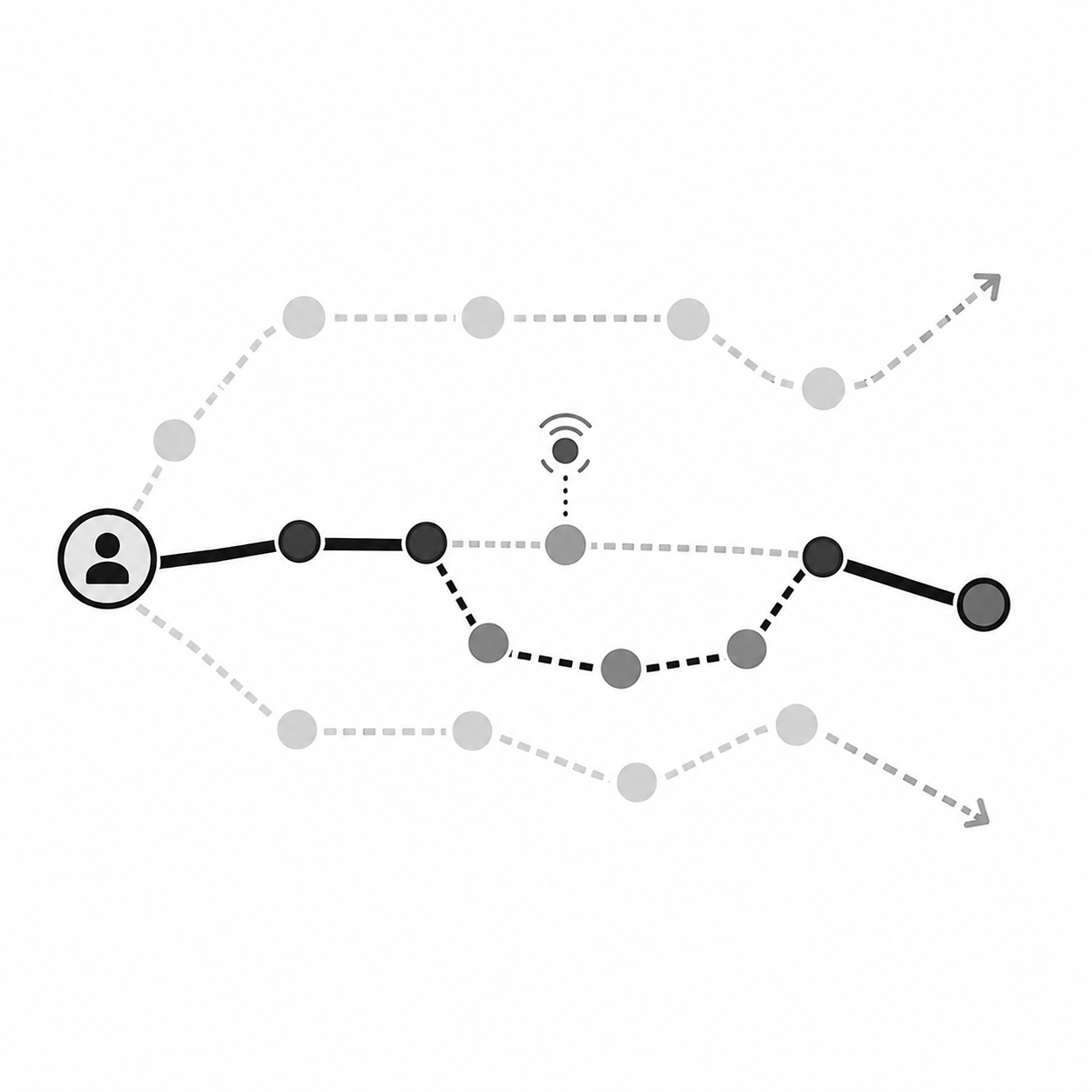
What if search didn't stop when you booked? What if an agent ran continuously in the background - monitoring your circumstances, potential journey, tracking real-time conditions, evaluating alternatives, surfacing better options before you know you need them? Not a notification that your train is late but an answer always at the ready: here's what to do, here's whether your existing ticket covers it, here's when you need to (or ideally should) leave.
This is technically achievable now in a way it wasn't five years ago. The underlying data is largely open. The reasoning capability exists. What's missing is the decision to build.
The teams that pull ahead in travel won't necessarily have the best booking flows, the biggest ad campaign or the most polished loyalty programmes. They'll be the ones that rethink aspects of what they do from first principles given new realities in technology and the market. In this example, going from search as a one time Q&A for booking, to an ongoing, intelligent, context-aware service. It requires letting go of the assumption that search is solved, or boring.
It isn't and it isn’t.